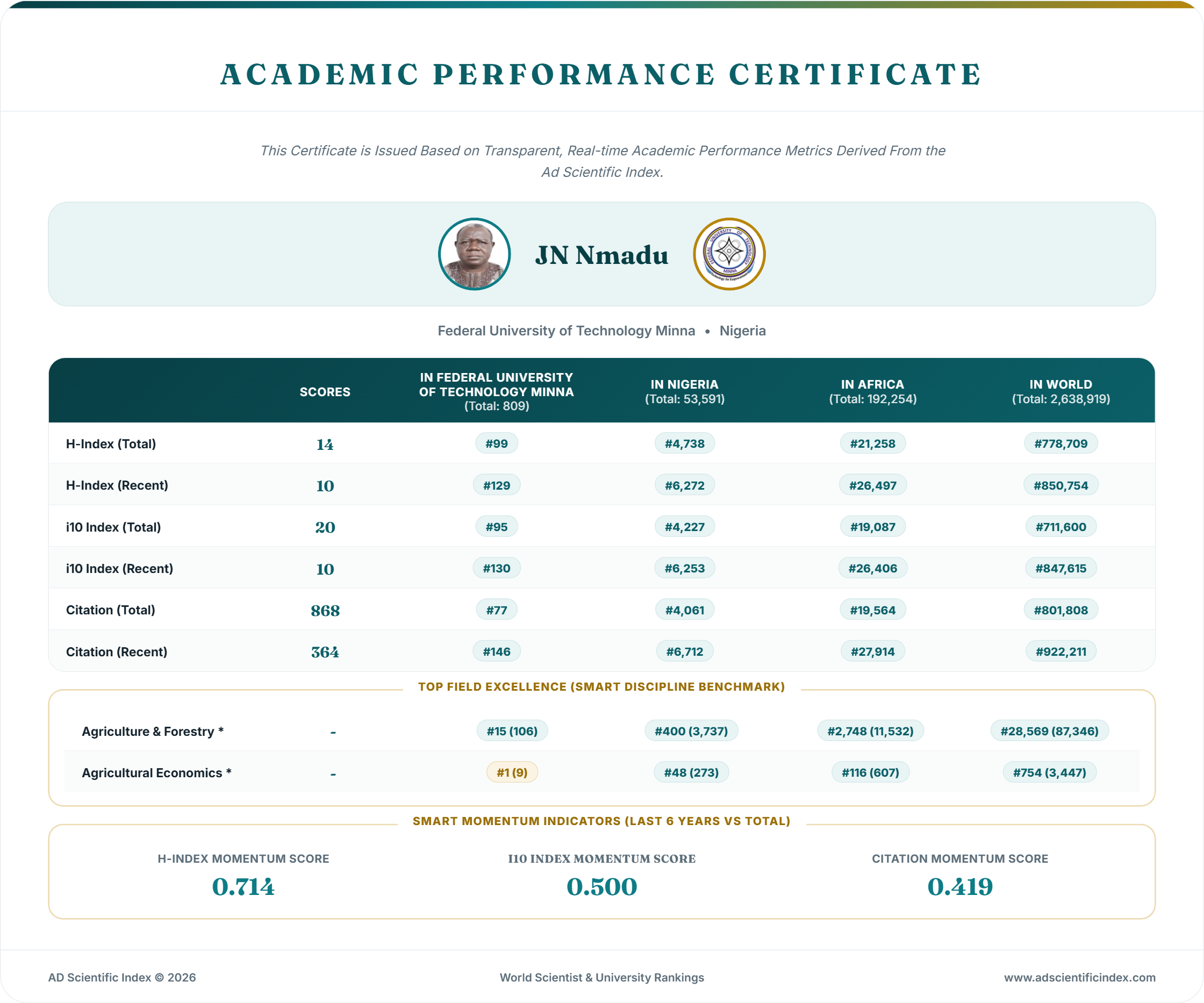
Academic, Teacher, Researcher, Consultant, Administrator and Community Leader with skills in Data Science and Machine Learning; Computable General Equilibrium Modeling and Students Advisor.
Data-Driven Development: Transforming complex agricultural research and interventions into actionable economic and welfare effects, empowering development.
Three decades of industry experience in teaching research and community development as Head of Department, Industrial Liaison Officer, Dean, Director, Consultant, Church and Community leader.
Education
PhD in Agricultural Economics, 2002
Ahmadu Bello University, Zaria
MSc in Agricultural Economics, 1998
Ahmadu Bello University, Zaria
Diploma in Data Processing and Computer Programming, 1995
Soft Design Computer Institute, Zaria
BSc in Agriculture, 1987
Ahmadu Bello University, Zaria
Interests
Agricultural, Development and Environmental Economics
This study examines the socioeconomic characteristics of farmers and their influence on participation in agricultural development programmes in Nigeria. Using descriptive analytical methods, the study analyses key demographic and institutional variables including age, gender, household size, educational attainment, cooperative membership, leadership participation, and access to agricultural institutions. The results indicate that most respondents fall within the economically active age group, suggesting strong potential for engagement in agricultural development initiatives. Male farmers constitute the majority of participants, reflecting gender disparities in access to productive resources and programme opportunities. The findings further show that relatively large household sizes provide family labour for farm activities, while higher levels of education enhance farmers’ capacity to access information, understand programme requirements, and adopt improved agricultural technologies. Cooperative membership also plays a significant role in facilitating access to extension services, credit facilities, and institutional support. However, only a small proportion of respondents hold leadership positions within farmer organizations, indicating possible inequalities in decision-making structures. In addition, variations in the accessibility of markets and agricultural institutions highlight infrastructural challenges faced by rural farmers. The study concludes that strengthening farmer organizations, improving institutional access, and addressing gender disparities are critical for enhancing smallholder farmers’ participation in agricultural development programmes. These findings provide useful insights for policymakers and development practitioners seeking to improve the effectiveness of agricultural interventions in developing economies.
Introduction Model tuning and estimation has evolved from simple extrapolation to sophisticated probabilistic modeling frameworks. In contemporary data science, decision-makers require more than estimates, the need for clear statements about likelihood, risk, and uncertainty are critical to correct decision-making. However, despite the advances in predictive modeling, there is a persistent limitation of making quick and robust decisions from the estimated probabilities. The estimates are often not meaningfully interpreted. This is where the odds_summary function becomes strategically important.
Introduction In today’s complex and dynamic world, understanding the stability and fragility of systems and users is crucial for ensuring resilience and mitigating potential risks. Resilience capacity and vulnerability index are important in measuring the ability of systems and users to withstand and recover from disruptions.
Resilience Capacity Resilience capacity refers to the ability of systems and users to absorb and adapt to disturbances, maintaining their functionality and performance. Resilience capacity has three components (Fig.
Introduction This blog is about the improved function, quicksummary in the Dyn4cast package. The function provides quick overview of data and particularly outputting five different means.
Observational study involves procuring large mass of data for analysis and modeling. So, there is always need to have an overview of the data to decide on the appropriate analysis to be undertaken. This is where this function is unique because five different means are computed simultaneously, in spite of the one line code arguments.